
 Español
 English
 Русский
 Français
 Deutsch
 简体中文
 Árabe
 Português
 日本語
 한국어
 हिंदी
 Prancis
 Türkçe
 Tiếng Việt
 Italiano
 ไทย

Gym Rubber Floor Mats vs. Polished Concrete: Cost, Safety & Long-Term Value
Choosing the right flooring for a commercial gym is more than a design decision. It affects your project budget, equipment protection, cleaning routine, training experience, and long-term maintenance costs.
Polished concrete is popular in modern fitness facilities because it offers a clean, industrial appearance and can be relatively economical when a suitable concrete slab already exists. However, it does not provide the same cushioning and impact protection as a properly selected rubber flooring system.
For gym contractors, fitness facility owners, commercial property developers, and flooring distributors, the real question is not simply which material costs less. It is which flooring solution best fits the training activities, operating conditions, and total project budget.
This guide compares gym rubber floor mats and polished concrete across installation costs, safety, maintenance, durability, and purchasing considerations to help you make a more informed decision.
1. Gym Rubber Floor Mats vs. Polished Concrete: Quick Comparison
Both surfaces have a place in commercial fitness facilities, but they serve different purposes.
| Comparison Factor | Gym Rubber Floor Mats | Polished Concrete |
|---|---|---|
| Initial cost | Depends on thickness, material, format, and installation | May be economical when the existing slab needs minimal preparation |
| Impact protection | Helps cushion impacts and protect the underlying floor | Offers little cushioning for dropped weights |
| Noise control | Can reduce some impact and equipment noise | Impact noise can be more noticeable |
| Training comfort | More forgiving underfoot | Hard and unforgiving |
| Cleaning | Requires suitable cleaning methods; seams and textured surfaces need attention | Generally easy to sweep and maintain when properly finished |
| Durability | Depends on material quality, thickness, traffic, and maintenance | Can be durable, but the finish may scratch, stain, or require renewal |
| Repair | Individual tiles or sections may be replaceable | Repairs can be difficult to blend with the surrounding finish |
| Design | Available in different colors, textures, thicknesses, and formats | Offers a consistent, minimalist appearance |
| Best applications | Free-weight areas, strength zones, functional training, and equipment areas | Circulation routes, reception areas, and selected low-impact zones |
The practical takeaway: Polished concrete can be suitable for circulation and selected general fitness areas. A suitable gym rubber floor mat is often the more practical option where dropped weights, repeated impacts, equipment protection, and underfoot comfort are important.
The final choice should reflect actual use, rather than appearance or material price alone.

2. Is Polished Concrete Cheaper Than Gym Rubber Flooring?
Polished concrete can have a lower apparent cost, especially when the building already has a suitable concrete slab. However, comparing the concrete finishing quote with the price of rubber flooring alone does not give you the full project cost.
For a commercial gym, evaluate the complete flooring system.
What affects the cost of polished concrete?
The total cost may include:
Concrete grinding, polishing, and surface preparation.
Crack repair and correction of surface defects.
Staining, sealing, or other specified finishing treatments.
Labor, equipment, and site preparation.
Future maintenance or refinishing, depending on traffic and finish requirements.
If the existing slab is in good condition, the cost can be competitive. If substantial repairs or additional treatments are needed, the budget may increase.
What affects the cost of gym rubber floor mats?
Rubber flooring quotation may include:
Rubber material, thickness, density, and surface finish.
Tiles, rolls, or other product formats.
Cutting, edge finishing, and custom dimensions.
Subfloor preparation and installation labor.
Freight, packaging, import charges, and applicable taxes.
Replacement materials and routine maintenance over time.
For imported commercial gym flooring, buyers should also distinguish the factory product price from the landed cost. Freight, customs duties, inland delivery, and installation can materially affect the final project budget.
How to compare long-term flooring costs
Instead of choosing the lowest initial quote, compare the costs across the expected service life.
Total flooring cost = Initial installation + Maintenance + Repairs and replacements + Relevant downtime costs
This is a planning framework, not a fixed pricing formula. Actual costs depend on the facility, local labor rates, usage intensity, and maintenance schedule.
For example, a gym with frequent barbell drops may face more floor damage and disruption if it relies entirely on an unprotected concrete surface. In contrast, a low-impact fitness studio may not need extensive rubber coverage.
The best way to control costs is to specify the right material for each zone rather than automatically selecting the most expensive or cheapest option.
3. Safety and Impact Protection: What Should Gym Owners Consider?
Safety is a major concern when choosing commercial gym flooring. However, neither polished concrete nor rubber should be considered automatically safe in every situation.
The appropriate solution depends on the exercise type, surface condition, equipment, footwear, moisture, and installation quality.
Where polished concrete has limitations
Polished concrete provides a firm, stable surface for many activities. Its limitations become more relevant in areas with repeated heavy-weight impacts.
Limited cushioning: Concrete provides little impact absorption when weights are dropped.
Impact noise: Dumbbells and barbells striking a hard surface can generate considerable noise.
Equipment and slab protection: Repeated impacts may damage the floor finish or underlying slab, depending on the load and construction.
Moisture management: Sweat, spills, and cleaning residues can affect traction. Actual slip resistance depends on the finish and maintenance.
For these reasons, polished concrete alone may not be the most suitable choice for a high-intensity free-weight zone.
How gym rubber mats can help
A properly specified gym rubber floor mat creates a protective layer between training equipment and the underlying slab.
Potential benefits include:
Helping absorb some impact from dropped weights.
Reducing direct contact between equipment and the concrete floor.
Reducing some impact noise and vibration.
Providing a more forgiving surface for standing and strength exercises.
Allowing damaged sections to be replaced when the flooring system is designed for sectional repair.
Performance varies by product construction, thickness, density, subfloor, and impact conditions. A standard rubber mat should not be assumed to provide sufficient protection for every heavy-lifting application.
For Olympic lifting, repeated heavy drops, or specialized strength facilities, ask the manufacturer to recommend a suitable flooring system for the actual loads and training conditions.
Does rubber flooring prevent slips?
Not automatically. Rubber flooring can provide useful traction, but performance depends on the surface texture, contamination, moisture, and cleaning practices.
Before purchasing, ask for relevant test documentation where slip resistance is a project requirement. Confirm that the test method and results apply to the specific product being quoted.
For gym owners and contractors, the objective is to select flooring that supports the intended activities while maintaining an appropriate cleaning and inspection routine.
4. Maintenance: Which Flooring Is Easier to Manage?
Daily maintenance affects labor costs, appearance, and facility operations. The easier surface to maintain depends on the product finish, traffic level, cleaning equipment, and local operating conditions.
Maintaining polished concrete
Polished concrete is generally straightforward to sweep and clean. Its relatively continuous surface can be an advantage in open circulation areas.
However, facility managers should consider:
Regular dust and debris removal.
Prompt cleaning of sweat, spills, and other contaminants.
Suitable cleaning products that will not damage the specified finish.
Periodic inspection for cracks, surface wear, and areas requiring resealing or refinishing.
Concrete may be practical for high-traffic walkways, but the surface should still be inspected and maintained.
Maintaining gym rubber floor mats
Rubber flooring requires a maintenance routine appropriate to the product and installation method.
Important considerations include:
Sweeping or vacuuming loose dirt and debris.
Using a manufacturer-approved cleaner.
Avoiding cleaning chemicals that may damage the rubber or its binder.
Checking joints, edges, and transitions for movement or gaps.
Inspecting high-impact areas for wear, compression, or damage.
Allowing the floor to dry properly after cleaning.
Textured rubber surfaces and joints can collect debris, so cleaning methods should match the flooring design.
Odor is another purchasing consideration. Some rubber products may release a noticeable odor after unpacking, and the intensity can vary with material composition, manufacturing, packaging, and storage. Ask about material information, available emissions or chemical test reports, and recommended ventilation before placing a large order.
Buying tip: Request a sample and evaluate its surface, odor, cleaning response, and overall finish before approving the material for a full commercial project.
5. Which Areas Need Rubber Flooring in a Commercial Gym?
A commercial gym does not necessarily need one flooring material throughout the entire building. Combining polished concrete with gym rubber floor mats can help balance budget, functionality, and appearance.
Free-weight and strength training areas
These zones typically benefit most from suitable rubber flooring because dumbbells, barbells, racks, and strength equipment can expose the floor to repeated impact.
Choose a product based on the actual equipment loads, expected weight drops, and frequency of use.
CrossFit and functional training zones
These areas may involve sled work, kettlebells, dynamic movements, and high-intensity training.
Consider durability, traction, cleaning requirements, and whether different exercises require distinct flooring zones. Specialized lifting platforms may be appropriate for particular activities.
Cardio and machine areas
Rubber flooring can help protect the floor beneath treadmills, bikes, rowing machines, and resistance equipment. The required thickness depends on equipment weight, movement, and the manufacturer's recommendations.
For lighter-use areas, compare the cost of full rubber coverage with targeted mats or other suitable surfaces.
Reception, corridors, and circulation areas
Polished concrete may be a practical choice where cushioning is less important and a continuous architectural finish is desired.
The surface should still meet the project's slip-resistance, accessibility, cleaning, and maintenance requirements.
Schools, hotels, and community fitness facilities
These projects often need to balance durability, budget, appearance, and ease of maintenance. The right flooring depends on whether the space is used for weight training, general exercise, recreation, or circulation.
For contractors, dividing the facility into functional zones before requesting quotations can reduce material waste and help ensure that each surface meets its intended purpose.
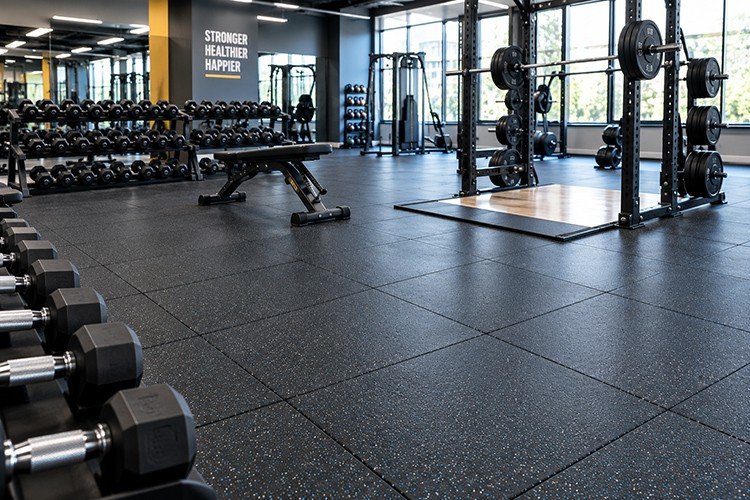
6. How to Choose the Right Gym Rubber Floor Mat for a Commercial Project
Once you have identified the areas that require rubber flooring, the next step is to specify the right product.
A low quotation is only useful when the quoted material meets the project's requirements.
Thickness and application
Do not select thickness based on price alone.
A thicker mat is not automatically better for every application. The required thickness depends on equipment weight, impact severity, subfloor conditions, and whether the flooring is used for general fitness or heavy lifting.
Provide your supplier with the intended application and request a recommendation supported by product specifications.
Material and construction
Ask about the rubber composition, manufacturing method, surface finish, and relevant test documentation.
These details help buyers compare products with similar appearances but potentially different performance characteristics.
For projects with indoor air quality or chemical compliance requirements, request the applicable documentation for the exact product and market. Do not rely on general claims that all rubber mats are low-odor or compliant.
Tiles vs. rolls
The format affects installation, transportation, maintenance, and future repairs.
Rubber tiles: Can be practical for sectional replacement, defined zones, and projects requiring modular layouts.
Rubber rolls: Can reduce the number of visible joints across larger continuous areas, although handling, cutting, subfloor preparation, and installation still require planning.
The better option depends on the room layout, desired appearance, traffic, installation method, and replacement strategy.
Size, color, and customization
For commercial projects, customized dimensions and color options can help coordinate flooring with the facility's branding and design.
Depending on the product and production requirements, buyers may ask about custom sizes, color combinations, logo integration, edge treatments, and packaging.
Confirm the available customization options, minimum order quantity, lead time, and production tolerances before finalizing the specification.
Samples and quality documentation
Before approving a bulk order, consider requesting:
A physical sample to evaluate appearance, texture, and odor.
A written specification covering dimensions, thickness, material, and color.
Relevant test reports and certification documents, where applicable.
Installation and cleaning guidance.
Packaging details and an estimated delivery schedule.
These checks are particularly useful for contractors, importers, wholesalers, and distributors who need consistency across multiple projects or repeat orders.
7. Why Factory-Direct Sourcing Can Help Commercial Flooring Buyers
For large gyms, renovation projects, and wholesale programs, the supplier relationship can affect both procurement cost and project coordination.
Working directly with a manufacturer can simplify communication about product specifications, customization, samples, and production planning. It does not automatically guarantee the lowest total cost, so buyers should compare quotations on an equivalent specification and delivery basis.
When evaluating a factory-direct supplier, consider the following.
Specification control: Can the supplier confirm the product dimensions, thickness, color, and construction in writing?
Customization: Can the factory support the required sizes, colors, logo options, and packaging for your project or distribution business?
Supply capacity: Can the manufacturer accommodate the order quantity and communicate a realistic production and delivery schedule?
Quality evidence: Can the supplier provide samples, applicable test documentation, and product-specific technical information?
Export support: Can the supplier assist with the documents, packing information, and shipping coordination required for your destination market?
For buyers sourcing indoor or outdoor rubber flooring, these questions help establish whether a supplier can support an individual installation, a multi-site project, or a recurring wholesale program.
As a source factory supplying rubber matting solutions, we can discuss project requirements, available specifications, and customization options with buyers before a quotation is finalized. Sample availability, production schedules, and supporting documents should be confirmed for the specific product and order.
8. Commercial Gym Flooring Buying Checklist
Before approving your flooring purchase, confirm the following:
The facility has been divided into functional flooring zones.
The selected surface is suitable for the intended exercises and equipment.
The subfloor condition and preparation requirements have been assessed.
Rubber mat thickness and construction have been matched to the application.
Installation, maintenance, and replacement requirements are understood.
The quotation includes the relevant material, freight, installation, and other project costs.
Samples and written product specifications have been reviewed.
Applicable test reports and compliance documents have been checked.
Customization, order quantity, packaging, and lead time have been confirmed.
A well-defined specification helps reduce misunderstandings between the buyer, contractor, installer, and manufacturer.
9. Frequently Asked Questions
Are gym rubber floor mats better than polished concrete?
Neither material is universally better. Rubber mats are often more suitable for free-weight areas and activities involving repeated impacts. Polished concrete can work well in circulation areas and selected low-impact spaces. Many commercial gyms benefit from using both materials in different zones.
How much do commercial gym rubber floor mats cost?
Pricing depends on material composition, thickness, dimensions, product format, order quantity, and destination. Installation labor, shipping, import charges, and subfloor preparation may add to the total. Request a quotation based on your project area and application rather than comparing material prices alone.
What thickness of rubber mat is best for a commercial gym?
There is no single thickness suitable for every gym. General fitness areas, cardio zones, strength areas, and heavy-lifting platforms have different requirements. Provide the supplier with details about the equipment, weight-drop conditions, and subfloor so that the specification can be selected appropriately.
Are rubber gym mats suitable for heavy weights?
Some rubber flooring products are designed for strength training and weight-room use, but not every mat is suitable for repeated heavy drops. Confirm the product's intended application and obtain technical recommendations for the actual loads and training conditions.
Are rubber floor mats difficult to clean?
They are generally manageable with regular sweeping, suitable cleaning products, and periodic inspection. Cleaning effort depends on the surface texture, joints, traffic, and contamination. Always follow the product-specific maintenance instructions.
Can I order custom gym rubber mats directly from a factory?
Depending on the product and order requirements, factory-direct suppliers may offer custom dimensions, colors, logos, and packaging. Confirm the available options, minimum order quantity, sample arrangements, production lead time, and technical documentation before ordering.
What should importers ask a rubber gym mat manufacturer?
Ask for product specifications, sample availability, quality documentation, customization options, packaging details, minimum order quantity, lead time, and export support. For repeat orders, also clarify how approved specifications and color consistency will be maintained.

Final Thoughts: Choose Flooring for the Way Your Gym Operates
Polished concrete can be a cost-effective and visually appealing surface for selected commercial gym areas. However, its limited cushioning makes it less suitable as the sole protective surface in many free-weight and heavy-impact zones.
Gym rubber floor mats can provide additional impact protection, equipment protection, and underfoot comfort when the product is matched to the intended use. Their value depends on correct specification, installation, and maintenance—not simply on choosing the thickest or most expensive option.
For commercial gym owners, contractors, importers, and distributors, the most practical approach is to assess each zone, compare total project costs, and confirm product specifications before placing an order.
Planning a commercial gym flooring project?
Share your application, approximate floor area, preferred mat dimensions, thickness requirements, and delivery destination. Our team can help you review available rubber flooring options, discuss customization, and confirm sample availability and quotation details for your project.
Online Message
RELATED PRODUCTS

This premium four tone landscaping synthetic turf is an enhanced, high-grade solution tailored for professional landscaping use.Unlike conventional single-color or dual-color grass systems, this advanced landscaping synthetic grass adopts an innovative four-tone blending technology, combining deep green, light green, fresh green, and natural straw-yellow fibers. The result is a highly realistic landscaping synthetic grass surface that closely replicates the natural color variation and layered texture of real lawns.
Transform your outdoor space with our premium three-tone landscaping artificial turf, engineered to deliver the luxurious appearance of a perfectly maintained natural lawn. Designed for upscale residential landscapes and commercial environments, this high-end landscape turf grass features a sophisticated blend of deep forest green, fresh field green, and realistic tan thatch fibers to recreate the authentic texture, color variation, and depth of real grass.
Transform your outdoor spaces into a vibrant, evergreen oasis with our premium outdoor artificial turf carpet. Engineered specifically to withstand the harshest elements, this high-density outdoor grass turf carpet delivers the lush look and soft feel of natural grass without the endless hassle of watering, mowing, or fertilizing.
Gym turf flooring is engineered synthetic surface systems designed to deliver high-performance training conditions for strength, speed, and functional fitness exercises. Built with dense, resilient fibers and a reinforced backing structure, gym turf flooring provides a stable, impact-resistant surface that supports sled pushes, agility drills, HIIT workouts, and heavy training equipment use without compromising durability or comfort. The consistent surface texture of gym turf rolls helps improve traction and control, making it suitable for both professional and home training environments.
Outdoor rubber playground flooring is an engineered safety surfacing solution designed to create a soft, impact-absorbing ground layer for recreational and activity areas. It is widely used in environments where fall protection, comfort, and durability are essential. The structure of outdoor rubber playground flooring combines elasticity and strength, helping reduce the risk of injuries caused by slips, trips, and falls while maintaining stable performance under frequent use and changing weather conditions.
The 1 2 inch thick rubber mat roll is a heavy-duty flooring solution engineered for high-impact strength training environments. Designed as premium rubber gym rolls, it delivers exceptional shock absorption, subfloor protection, and long-term durability for commercial and professional fitness spaces. The dense construction of this rubber gym mat roll ensures stability under extreme loads, making it suitable for areas where heavy weights, machines, and repetitive impact activities are common. Its fine-textured surface enhances traction, helping athletes maintain grip and safety during high-intensity workouts.
Rubber gym flooring rolls are continuous surface systems designed to deliver stable impact absorption, reliable traction, and long-term durability in high-intensity training environments. The dense rubber composition helps disperse force during movement, reducing stress on joints while maintaining a firm and supportive surface for dynamic exercises. As a continuous rubber roll structure, rubber gym flooring rolls ensure uniform coverage across large areas, minimizing seams and creating a safer, more consistent training surface.
Rubber gym flooring tiles are high-performance flooring solutions designed to create a stable, impact-resistant, and comfortable training surface. Built with dense rubber composition, these rubber gym flooring tiles help reduce noise, absorb shock, and protect both the subfloor and equipment during intensive workouts. Whether used in strength zones or functional training areas, rubber gym flooring tiles provide consistent underfoot support and long-term durability under heavy load conditions.
The rubber gym mats are high-performance flooring systems designed to provide reliable support, effective shock absorption, and durable performance in fitness and training environments. Each rubber gym floor mats panel is constructed using high-density compressed rubber, forming a resilient surface capable of withstanding repeated impact and heavy daily use. The gym floor mats create a protective base that enhances training safety while maintaining consistent performance under dynamic movement.
The interlocking rubber tile is a high-performance flooring system designed to deliver stable support, shock absorption, and long-term durability for training environments. Each interlocking rubber floor tile is manufactured with precision interlocking edges, allowing multiple tiles to lock tightly together and form a unified surface. This structure ensures the interlocking rubber gym floor tiles remain stable even under continuous high-impact movement.
